

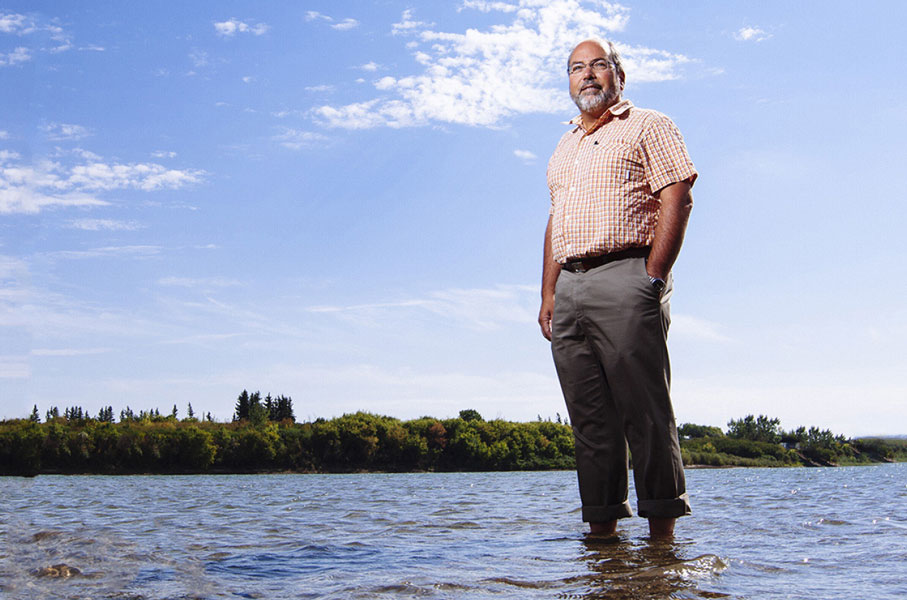
USask researcher focuses on sustainability of Canada’s freshwater
A USask researcher is leading the Global Water Futures Observatories (GWFO), a network of freshwater monitoring and observation stations placed strategically across the country that plays a key role in determining the security and sustainability of Canada’s freshwater.
GWFO provides open access to its freshwater data. It provides this urgently needed data to support flood, drought, and water quality solutions that help safeguard Canadian water resources.
Dr. John Pomeroy (BSc’83, PhD’88), a USask professor, alumnus, and world-renowned hydrologist, serves as the director of the GWFO, which is led by USask in partnership with eight other Canadian universities. With funding from the Canada Foundation for Innovation, GWFO is a network consisting of 64 instrumented drainage basin, lake, glacier, river, and wetland observation sites, 15 deployable water measurement systems, and 18 water laboratories is in operation. GWFO is a pan-Canadian network of advanced observation sites, deployable systems, and specialized labs. It delivers “deep data” across major river basins and lakes, enabling early warning systems, predictive models, and evidence-based water management strategies providing an early warning system for freshwater across the country.
The GWFO monitoring sites are scattered across both remote and populous locations in Canada, from within the Great Lakes to atop glaciers and mountaintops. The network provides cutting-edge data to researchers and has helped inform water prediction models used by the United Nations. These monitoring stations support Canadians in finding solutions for water issues related to climate change, sustainable management of water resources, freshwater for communities, energy and agriculture, ecosystem conservation, and much more.
In addition to his role with the GWFO, Pomeroy—the world’s most-cited snow hydrologist—is the director of USask’s Centre for Hydrology, a member of the Global Institute for Water Security, a United Nations Educational, Scientific and Cultural Organization (UNESCO) Chair in Mountain Water Sustainability, and a distinguished professor in the Department of Geography and Planning in the College of Arts and Science. Pomeroy co-chairs the UN Advisory Board for the International Year for Glaciers’ Preservation and chairs the UN’s Committee for the Decade of Action for Cryospheric Sciences. He is the recipient of the 2025 International Hydrology Prize – Dooge Medal, awarded by the International Association of Hydrological Sciences, UNESCO, and the World Meteorological Organization.