

USask spearheads AI-driven detection of early Alzheimer’s disease
USask researchers are bridging biology and data science to develop a new, non-invasive artificial intelligence (AI) screening tool for those at risk for Alzheimer’s disease.
It’s estimated that more than 50 million people around the world are currently living with Alzheimer’s disease and related dementia, a number that is set to triple by 2050. In Saskatchewan, 2.3 per cent of people over the age of 65 have been diagnosed with the disease.
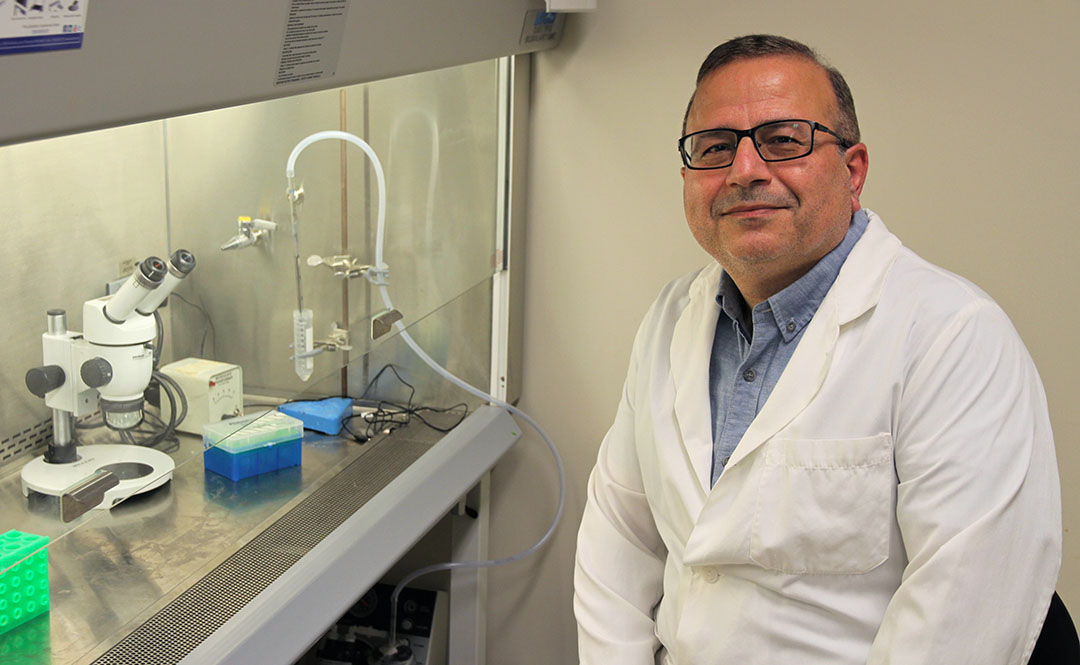
The goal of the project—which received a $150,000 Impact Grant as part of the Saskatchewan Health Research Foundation (SHRF) Solutions Program—is to develop an AI algorithm that could detect very early signs of Alzheimer’s disease using routine ophthalmological scans of the retina, known as optical coherence tomography (OCT). USask College of Medicine researcher Dr. Changiz Taghibiglou (PhD) and USask alumna Dr. Ming Fang (PhD’25) will train an algorithm to identify patterns of degeneration related to Alzheimer’s disease using OCT data from patients in Saskatoon, Regina, and Prince Albert.
This interdisciplinary project includes researchers from neuroscience, computer science, medicine, and more, such as Saskatoon optometrist, USask alumnus, and co-principal investigator Dr. Kerry Bishop (BSc’97, OD). Other collaborators include Dr. Andrew Kirk (MD), Dr. Ravikrishna Nrusimhadevara (MD), and Dr. Francisco Cayabyab (PhD) from the College of Medicine, Dr. Seok-Bum Ko (PhD) and Dorsa Robatjazi (Master of Science degree candidate) from the College of Engineering, and USask alumna and ophthalmologist Dr. Melody Wong (MD’18).