

Educational Attainment and Employment Rates
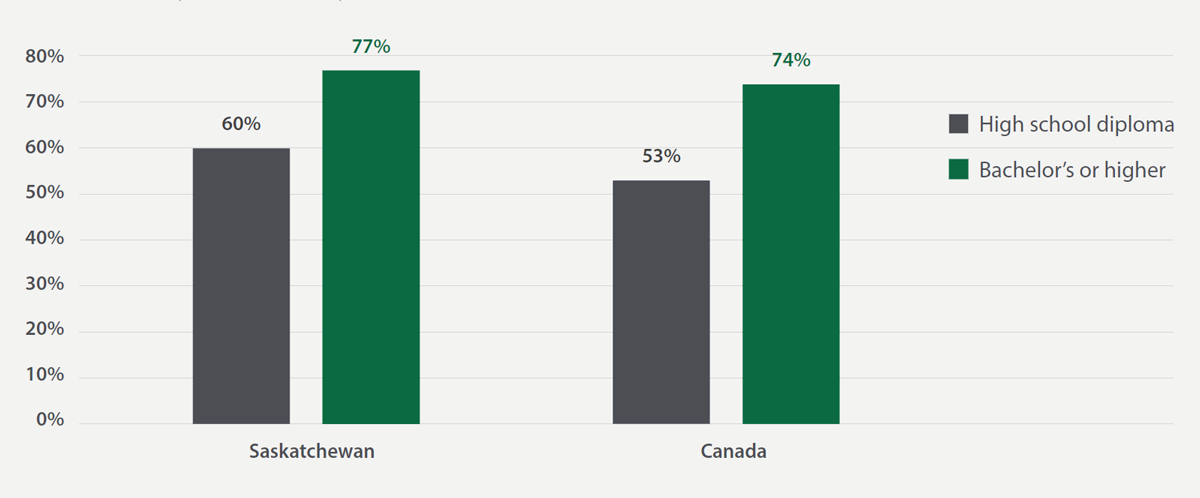
Higher education contributes to the livelihoods and careers of Saskatchewan residents in two ways: higher employment rates and higher earnings.19 In Saskatchewan, the employment rate for individuals with a bachelor’s degree or higher is 77% compared to 60% for individuals with a high school degree, as shown in Figure 13.20
Saskatchewan’s employment rates for both individuals with high school diplomas and with bachelor’s degree or higher exceed the national average. In Canada, the average employment rate for individuals with bachelor’s degrees or higher was 74% and for high school diplomas was 53%.21
FIGURE 13. Employment Rates by Highest Degree Attained, 2024
Educational Attainment and Lifetime Earnings
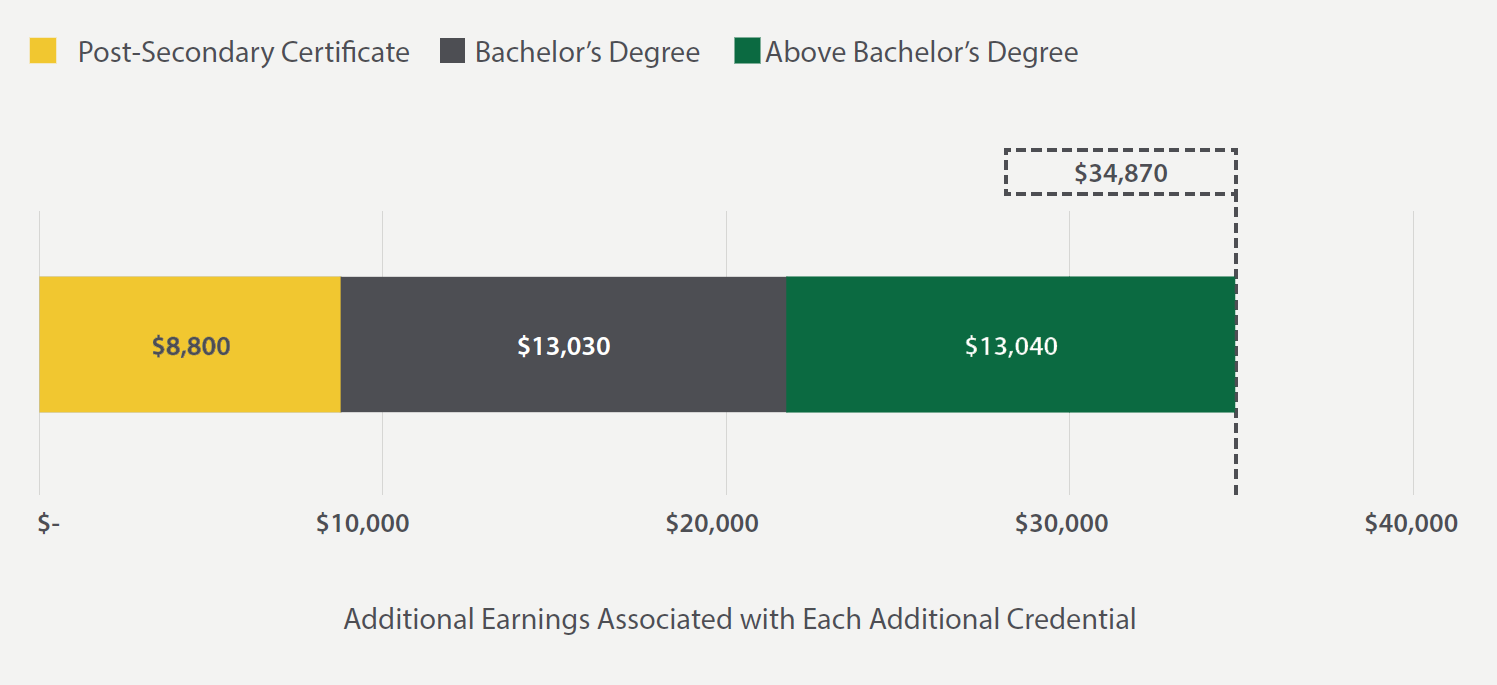
The earnings premium is the difference in average salaries or earnings between individuals with higher levels of education and those with lower levels of education. In Saskatchewan, the difference between the earnings of a resident whose highest educational level is a high school diploma versus a graduate degree is sizable : $34,870. For each additional degree earned at USask, the average annual earnings increases by $13,000 and by nearly $9,000 for a certificate, as shown in Figure 14.
FIGURE 14. Average Annual Earnings Premium at Each Additional Credential Level, Saskatchewan 2022
$1.3M+
Over a working lifetime of 40 years (25 to 64 years of age), an individual with a graduate degree will earn, on average, $1,394,000 more than a person with a high school diploma.
$13K
For each additional degree earned at USask, the average annual earnings increases by $13,000.
17%
In Saskatchewan, the employment rate for individuals with a bachelor’s degree or higher is 77% compared to 60% for individuals with a high school degree.
What does the earnings premium mean for a person’s total earnings? The average annual salary of a Saskatchewan resident with a high school diploma is $53,313. For a resident whose highest educational level is a post-secondary certificate, the average annual earnings are $59,526. The average annual earnings of a resident whose highest degree is a bachelor’s are $74,831, and for a resident with a graduate degree, the average annual earnings are $88,163. Simply put, average annual earnings rise with educational attainment levels, as shown in Figure 15.
FIGURE 15. Additional Earnings Premium at Each Credential Level and Average Annual and Lifetime Earnings at Each Credential Level in Saskatchewan, 2022
| Earnings Premium | Total Earnings | |||
| Credential Level | Annual | Lifetime (Ages 25–64) | Annual | Total Lifetime (Ages 25–64) |
| High School | $53,313 | $2,132,520 | ||
| Post-Secondary Certificate/Diploma | $8,800 | $352,000 | $59,526 | $2,381,040 |
| Bachelor's Degree | $13,030 | $521,200 | $74,831 | $2,993,240 |
| Graduate Degree | $13,040 | $521,600 | $88,163 | $3,526,520 |
Source: Province of Saskatchewan. (2025). Earnings premium of Saskatchewan post-secondary credentials, 2022 graduates.
Consequently, over a working lifetime of 40 years (25 to 64 years of age), an individual with a graduate degree will earn, on average, $1,394,000 more than a person with a high school diploma. (This is the difference between total average lifetime earnings of $2,132,520 and $3,526,520.) By increasing the educational attainment of the 4,500 students who graduate each year, USask contributes to the economic livelihoods of its graduates and to Canada’s competitive positioning as an advanced economy in the G7 and Organisation for Economic Co-operation and Development (OECD).
Spotlight
Loading...
Closing the Earnings Gap Across Gender and Ethnicity

The University of Saskatchewan educates students from throughout Saskatchewan, Canada and the world. The university strives to create a thriving, dynamic campus that welcomes and attracts a diverse student body, whether measured by gender, ethnicity, disability, or country of origin.
At the provincial and federal levels, investment in post-secondary education expands access to higher education, increases educational attainment, and helps address employment and income gaps among historically underrepresented demographic groups.
A recent Saskatchewan Ministry of Advanced Education report noted that although earning gaps persist for Indigenous people and for women, achievement of the highest levels of educational attainment (bachelor’s degree and above) narrow these gaps. Indigenous people who earn a professional degree or a graduate degree are often able to close the earning gap entirely.22 More investment is needed to ensure greater access.
FIGURE 16. Average Annual Earnings or Income by Self-Declared Indigenous Identity by Credential Level, 2022
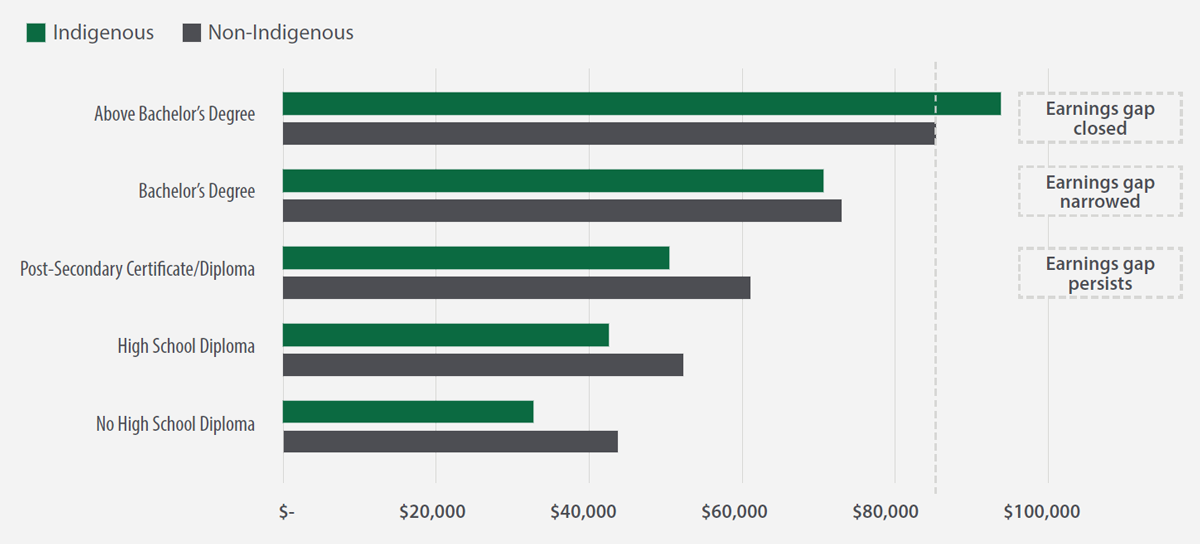
Figure 17 shows the number of students that graduated from USask in 2024/25 at the bachelor’s degree level or higher along with the average annual earnings for each demographic group.
IIn addition to highest level of educational attainment, average annual earnings are affected by type of job and industry, part-time vs. full-time status of employment, and years of work experience, among other factors. Nevertheless, comparing Figures 16 and 17, one can see that educational attainment is helping close earning disparities among demographic groups: Indigenous people in Saskatchewan 25 to 64 years of age with graduate degrees earn, on average, $93,850 per year. Figure 17 note.
FIGURE 17. University of Saskatchewan Number of Graduates by Demographic Group, 2024/25, and Average Annual Earnings by Demographic Group, 2022
| Credential Level and Demographic Group | Number of USask Graduates | Average Annual Earnings |
|---|---|---|
| High School Diploma | $53,313 | |
| Bachelor’s Degree or Higher | 4,729 | $76,488 |
| By Gender | ||
| Women | 2,730 | $67,436 |
| Men | 1,889 | $89,289 |
| By Ethnicity | ||
| Self-Declared Indigenous | 506 | $75,387 |
| Non-Indigenous | 4,223 | $76,713 |
Note: The average annual earnings are weighted averages of earnings for those with bachelor’s degrees and higher. For example, Indigenous people in Saskatchewan 25 to 64 years of age with graduate degrees earn $93,850 on average, while those with bachelor’s degrees earn $70,660 on average. The weighted average of $75,387 reflects the smaller proportion of Indigenous people who hold graduate degrees compared to bachelor’s degrees.
Sources: University of Saskatchewan (2025), University Data Warehouse; Statistics Canada (2022), Highest Level of Education, Saskatchewan, 2021 Census, Table 98-10-0384-01 and 98-10-0414-01, 2021; Saskatchewan Ministry of Advanced Education (2025), Earnings Premiums of Saskatchewan Post-Secondary Credentials: 2022 Graduates.
Figure 17 also shows the persistent earnings gap between Saskatchewan women and men with bachelor’s degrees or higher, although women now account for the majority of USask graduates each year. Women working in Saskatchewan report average annual earnings of $67,436 compared to $89,289 reported by men.
Increasing educational attainment at a provincial scale takes decades. USask is at the forefront of the province’s efforts to ensure equal access of all demographic groups to higher education and increasing the educational attainment and economic livelihoods of previously underrepresented demographic groups.
- In Organisation for Economic Co-operation and Development (OECD) countries, workers with a tertiary education earn an average of 56% more than those with only an upper secondary education. OECD. (2025). What are the earnings advantages to education? Education at a Glance 2024.
- Statistics Canada. (2025). Labour force characteristics by educational degree, annual, table 14-10-0118-01. The employment rate measures the percentage of the working-age population that has a job. Another often-cited measure is the labour force participation rate. The main difference between the two is that the labour force participation rate includes both employment and unemployed individuals who are actively looking for work.
- Ibid.
- Saskatchewan Ministry of Advanced Education. (2025). Earnings premium of post-secondary credentials: 2022 graduates.