

Signature Research Areas
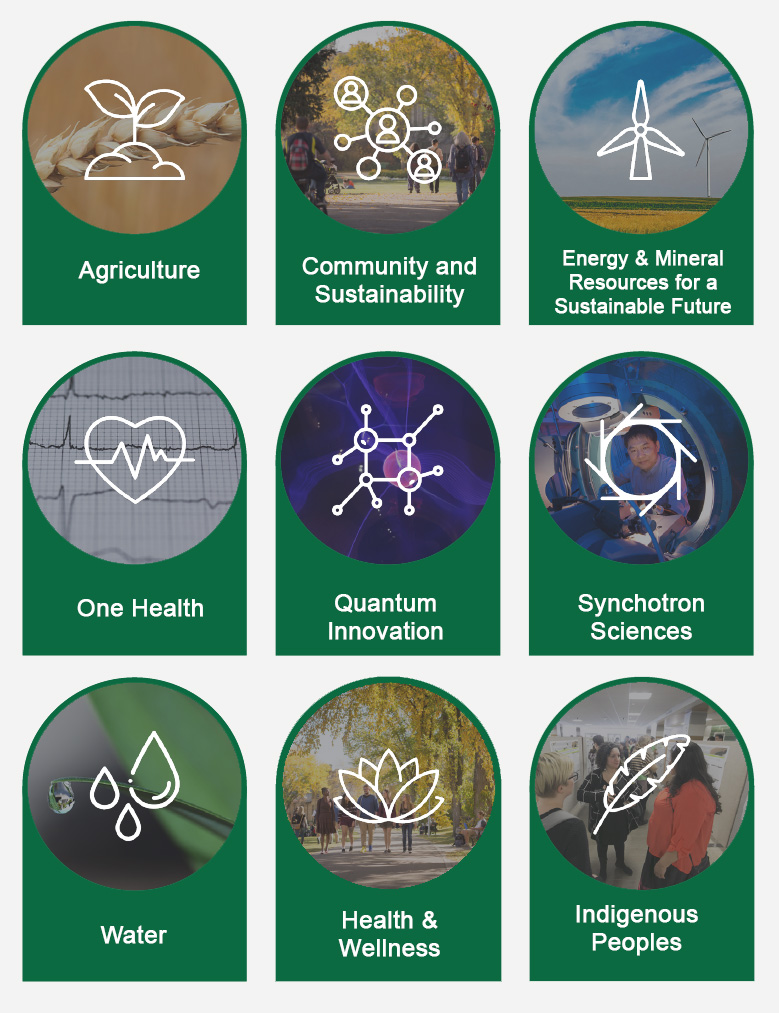
As a U15 Canada institution, USask performs world-leading research, scholarly and artistic work across a range of fields and disciplines. It has strengths in nine defined areas of research that span clean water, food production, Indigenous knowledge, energy, health, and materials science, as shown in Figure 18.
In addition to the research performed in USask’s colleges, the university is also home to world-class centres focused on finding solutions to complex local and global challenges. They include:
- Canadian Centre for the Study of Co-operatives
- Canadian Centre for Rural and Agriculture Health
- Canadian Hub for Applied and Social Research
- Canadian Light Source
- Crop Development Centre
- Global Institute for Food Security
- Global Institute for Water Security
- Super Dual Auroral Radar Network
- Sylvia Fedoruk Canadian Centre for Nuclear Innovation
- Vaccine and Infectious Disease Organization
FIGURE 18. University of Saskatchewan Signature Research Areas
4
USask is the only university in the country that is home to four flagship national research centres.
These centres are improving the health and safety of people in Saskatchewan and around the world. USask is the only university in the country that is home to four flagship national research centres: the Vaccine and Infectious Disease Organization (VIDO); the country’s only synchrotron at the Canadian Light Source (CLS); the Super Dual Auroral Radar Network (SuperDARN); and the Global Water Futures Observatories (GWFO).
The Vaccine and Infectious Disease Organization (VIDO) protects the world from infectious disease. In September 2025, it celebrated 50 years of protecting the health of people and animals and strengthening the country’s ability to prepare for future pandemics. VIDO is a key partner in the global “100 Days Mission” aimed at creating new vaccines within 100 days of identifying a pandemic threat. During the Covid pandemic, VIDO researchers isolated SARS-CoV-2 from the first Canadian case and was the first Canadian academic institution to move a vaccine candidate into clinical trials. In addition to its human pandemic work, VIDO has delivered eight commercial livestock vaccines, including six global firsts, that have helped farmers protect their herds and flocks and kept food affordable and available.23 Economically, VIDO’s activities have contributed over $511 million to Saskatchewan’s economy and more than 2,300 full-time jobs over the past decade.24 In 2016, VIDO developed a vaccine to combat a virus that has killed millions of pigs and cost the pork industry hundreds of millions.
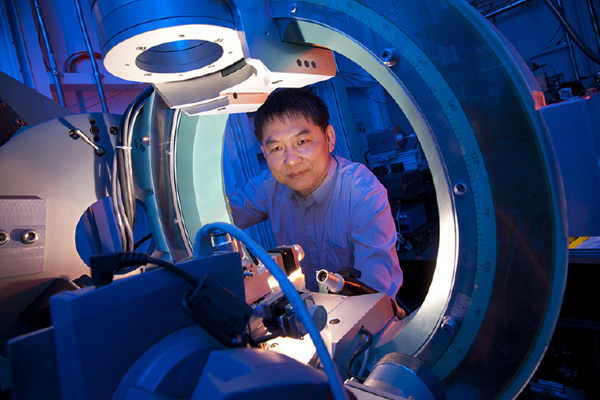
Canadian Light Source (CLS) is Canada’s only synchrotron research facility and a unique tool that researchers use to study the structures and properties of materials. Scientists from Canada and around the world have used the CLS to make major discoveries. For example, using the CLS, scientists pioneered enzyme-based blood conversion technology that enables conversion of type A blood into universal type O, offering new hope for addressing critical global shortages in blood and organ supply. In October 2025, Avivo, a Canadian company founded on this technology, achieved the world’s first blood type A-to-O kidney transplant.25 Researchers in a completely different field used the CLS to test a breakthrough lithium-ion battery whose charge can last over 8 million kilometres— outliving the lifespan of an electric vehicle and enabling decades of grid energy storage.26
8
In addition to its human pandemic work, VIDO has delivered eight commercial livestock vaccines, including six global firsts.
8M
Researchers used the CLS to test a breakthrough lithium-ion battery whose charge can last over 8 million kilometres.
500+
The CDC has released over 500 crop varieties across 40 types of crops.
The Global Institute for Water Security (GIWS) is the top water resources research institute in Canada and one of the most advanced cold region hydrology centres in the world. GIWS hosts the Global Water Futures Observatories (GWFO), a national freshwater research facility advancing flood, drought, and water-quality preparedness across Canada through enhanced monitoring at 64 water observing sites, supported by deployable observing systems and major laboratories.
The Super Dual Auroral Radar Network (SuperDARN) is a global network of scientific radars monitoring conditions in the near-Earth space environment. Space weather events can wreak havoc on communications systems. In 1989, a severe magnetic storm knocked out the 21,000 megawatt (MW) Hydro-Quebec electric power system and plunged the province into darkness for 9 hours.27 As one of the founding partners of SuperDARN, USask is working to improve prediction of space weather events to mitigate their impact on power grids, communication, and air travel.
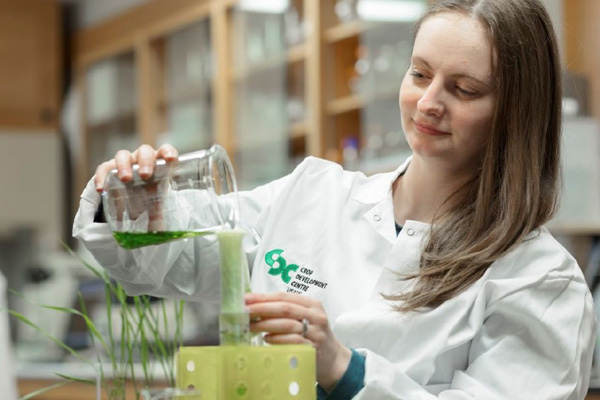
USask’s Crop Development Centre (CDC) has a history of excellence in plant breeding. Many of the new varieties created at the Centre have changed agriculture in Saskatchewan and around the world. Since 1871, the USask CDC has released over 500 crop varieties across 40 types of crops with improved traits to address current issues facing farmers, including climate change, production costs, disease and nutrition. Nearly 100% (99.8% to be exact) of lentils grown in Canada are varieties developed by researchers at the CDC.
A 2024 assessment report highlighted the CDC’s tremendous economic impact on Canada, including thousands of jobs and billions of dollars. A recent CDC Economic Footprint Assessment noted that for every $1 invested by the CDC across all crop types, growers saw a benefit-cost return of $11.28 The return was highest for lentil crops, at a benefit-cost return of more than $37 for every $1 invested. The report also highlighted that more than 530 peer-reviewed publications have been produced since 2016 and that more than 9,000 full-time jobs in Canada are estimated to be due to CDC plant breeding.
The Global Institute for Food Security (GIFS) at USask is a highly sought-after partner in agriculture and food innovation. Projections show that food production must double by 2050. USask is working to strengthen Saskatchewan’s agricultural leadership to help feed a hungry world adequately, safely, and sustainably. GIFS plays an integral role in this vision. From breeding acceleration to biomanufacturing and data analytics, GIFS is among a select group of global institutions equipped to drive innovation at scale. In 2025, PrairiesCan invested $1.6 million to support a genomic selection-based accelerated breeding program at GIFS. The program will enable breeding of multiple plant and livestock traits to changing environments. It will enable GIFS to offer these programs to diverse organizations in the public and private sectors promoting food security.
Spotlight
Loading...
Moving Up the Rankings
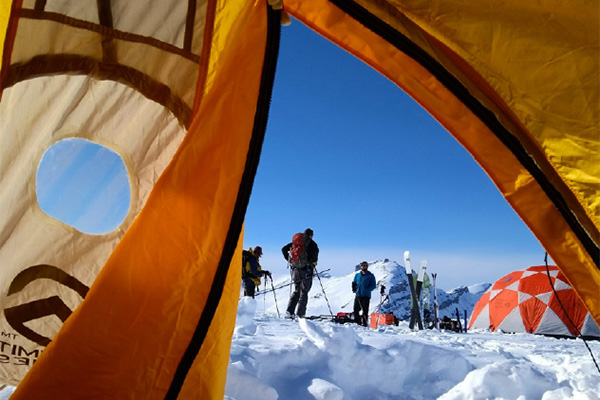
As USask’s research, scholarly, and artistic work enterprise has grown, the university has moved up the international rankings. These rankings are based on the quality of a USask education, its world-class areas of research excellence, and innovation activity. Evaluation of these criteria led to USask’s inclusion in the 401-500 tier of 2,000 universities worldwide in the 2021 Times Higher Education Rankings. Since 2023, the university has moved up and consistently ranked in the 351–400 tier.29
One factor driving this advance in rankings is the growth in USask research awards and expenditures over the past five years. Research awards are a lead indicator of competitive positioning to win external research funding. USask’s 5-year rolling average for research revenue grew 26% from 2019/20 to 2024/25.30 Research expenditures are lagging indicators. They indicate an institution’s capacity to execute on awarded research projects. USask’s research expenditures grew 34% from 2019/20 to 2024/25, as shown in Figure 19. Among the U15 Canada institutions, USask tied for fourth with the University of Calgary for growth in research expenditures over this 5-year period.
FIGURE 19. University of Saskatchewan Research Expenditures, 2019/20–2024/25
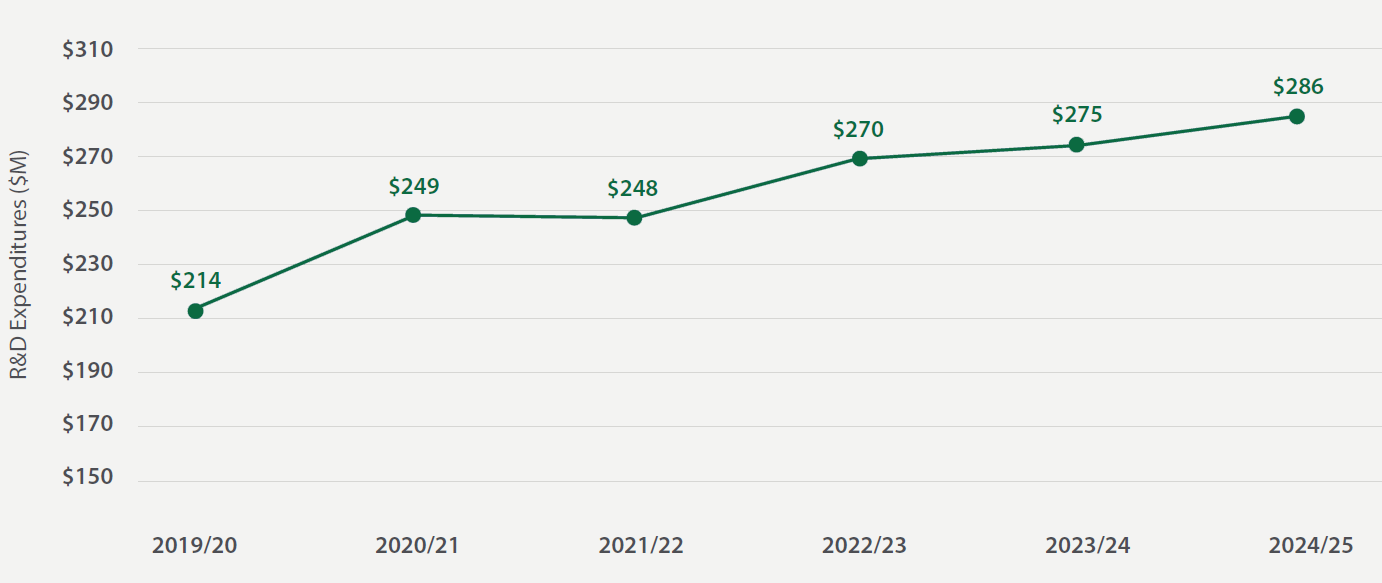
This growth has propelled USask from the bottom 20-40% to the middle 40-60% for research expenditures among 320 Canadian and U.S. research universities and academic medical centres that report to the Association of University Technology Managers (AUTM). RTI divided the 320 Canadian and U.S. research universities and academic medical centres into five equal groups based on the reported research expenditures of each institution. In 2018/19, USask, along with the University of Manitoba and the University of Victoria, ranked in the bottom 20-40% of Canadian and U.S. institutions by research expenditures. Five years later, in 2023/24, USask joined U15 Canada peers, the University of Waterloo, the University of Ottawa, and the University of Montreal, in the middle 40-60% of universities for research expenditures.
High Value Technology Licences and Startup Success
USask research, scholarly and artistic work provides students with applied experiences that sharpen critical thinking and generates new discoveries and knowledge that support problem-solving on the local, national, and global scale. Some research activity leads to the development of new technologies, products, processes, designs, and business models that are introduced by companies to the marketplace. This is commonly referred to as innovation.
FIGURE 20. University of Saskatchewan Performance on Key Tech Transfer Indicators Vis-à-vis Benchmark Universities with Similar Levels of R&D Activity, 2023/24
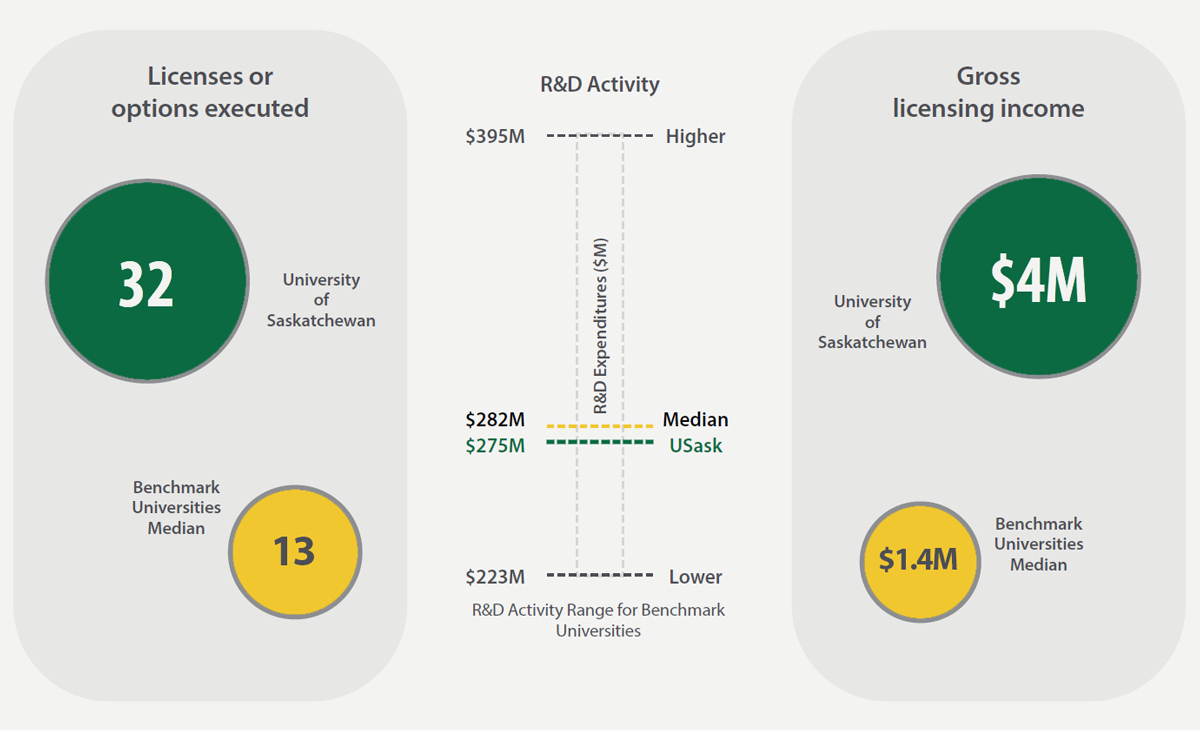
Note: RTI analyzed R&D expenditures, licences and options executed, and gross licensing income for 47 Canadian and U.S. universities and academic medical centres that report to the annual AUTM survey. The figure above shows the University of Saskatchewan’s tech transfer outcomes data in comparison to the median for the 47 institutions that reported $223 million to $395 million of R&D expenditures in 2023/24.
Universities licence their discoveries and technologies to both new and existing companies. One of USask’s strengths is the stability of its high-value licences. The income USask generates from licensing USask-developed technologies is consistently two to three times higher than peer institutions that perform similar levels of research activity, as shown in Figure 20.
In 2023/24, USask reported nearly $4 million of gross licensing income. This is nearly three times higher than the median of $1.4 million reported by 47 Canadian and U.S. research institutions with similar research expenditure levels.
USask research leads to licences of new crop varieties, vaccines, medical imaging technologies, tools (e.g., pharmacy prescribing guidelines), and novel extraction chemistries and technology that are highly valued by companies.
USask has also demonstrated increasing startup activity, as shown in Figure 21. Examples of successful startups include Skip the Kitchen, Excir, and PathoScan. These startups reflect the entrepreneurial thinking and innovation mindset on campus. The Opus program, started in 2022, provides startup support to researchers and students seeking to start ventures based on technologies invented at USask. The program has assisted 46 companies to date.
FIGURE 21. Startups Created at the University of Saskatchewan Vis-à-vis Benchmark Universities with Similar Levels of R&D Activity, 2023/24
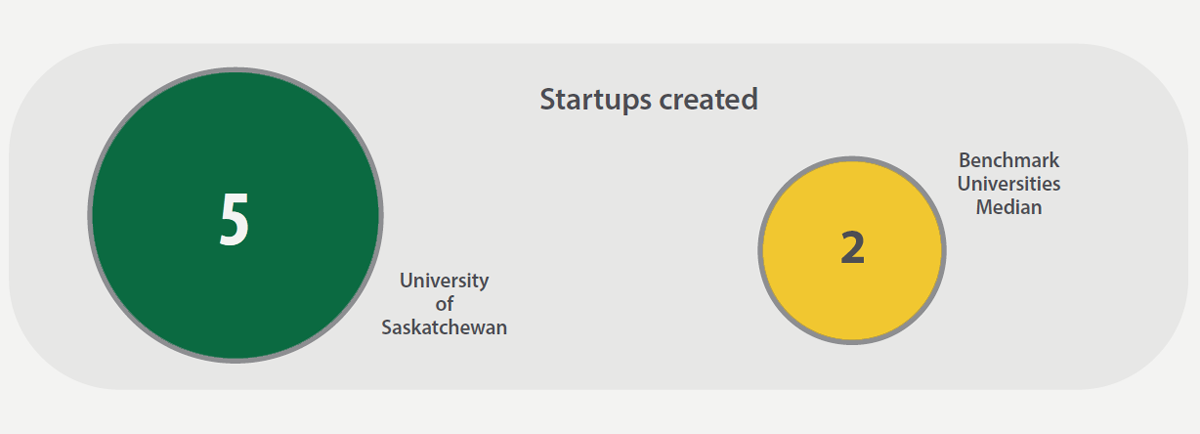
Note: RTI analyzed R&D expenditures and number of startups created for a benchmark group of Canadian and U.S. universities and academic medical centres that report to the annual AUTM survey. Please see the Appendix for the full list of benchmark peers. The figure above shows the number of startups reported by the University of Saskatchewan in comparison to the median for the 47 institutions that reported $223 million to $395 million of R&D expenditures in 2023/24.
- University of Saskatchewan. (2025, September 22). USask’s VIDO celebrates 50 years of protecting health, food security, and vaccine sovereignty
- Saskatoon Regional Economic Development Authority. (2022). University of Saskatchewan’s vaccine and infectious disease organization economic impact study.
- Zeng, J., Ma, M., Tao, Z. et al. (2025). Enzyme-converted O kidneys allow ABO-incompatible transplantation without hyperacute rejection in a human decedent model. Nature Biomedical Engineering. https://doi. org/10.1038/s41551-025-01513-6.
- Bond, T., R. Gauthier, G. King, R. Dressler, J. Abraham, & J. R. Dahn. (2024). The complex and spatially heterogeneous nature of degradation in heavily cycled li-ion cells. Journal of The Electrochemical Society 171, 11, 110514. https://doi.org/10.1149/1945-7111/ad88a8
- Government of Canada. (2025, July 25). Impacts of space weather: Chronology of effects. Accessed 30 October 2025. https://www.spaceweather.gc.ca/tech/se-chr-en.php
- EY Canada. (2024). Crop Development Centre Economic Footprint Assessment. Accessed 20 October 2025. https://cdc.usask.ca/impact/impact.php
- Times Higher Education. (2025). World university rankings (multiple years).
- Office of the Vice President Research, University of Saskatchewan. (2025). 2024-25 Annual Report.