

Indigenous People’s Empowerment
In Saskatchewan, there are an estimated 187,890 people from the 74 First Nations, Métis, and Inuit communities. They represent 17% of the provincial population, the largest proportion of Indigenous people among the Canadian provinces.31
USask strives to uplift Indigenous people. One way that USask underscores this commitment is by providing designated seats for Indigenous students in accordance with the deybwewin | taapwaywin | tapwewin: Truth Policy and process for verifying Indigenous membership/citizenship.32
Three examples of USask Indigenous-specific programs are teacher education, medicine, and law. Founded in 1972, the USask Indian Teacher Education Program (ITEP) is the largest First Nations teacher education program in the country. It recently celebrated its first 50 years and over 3,000 graduates. Over the past 10 years (2016- 2025), ITEP produced 454 graduates.
FIGURE 22. Self-Declared Indigenous Student Enrolment at the University of Saskatchewan, 2024/25
| Self-Declared Indigenous Students | All Students | ||
|---|---|---|---|
| Credential | Number of Students | % of Total Students | Total Students Enrolled |
| Undergraduate | 2,940 | 14% | 21,267 |
| Graduate | 413 | 9% | 4,569 |
| Total | 3,353 | 13% | 25,831 |
Source: University of Saskatchewan (2025). University Data Warehouse.
Another USask four-year Bachelor of Education program for Métis teachers in urban settings is the Saskatchewan Urban Native Teacher Education Program (SUNTEP). USask launched SUNTEP in 1980 in partnership with the Gabriel Dumont Institute and the University of Regina. SUNTEP is offered in Saskatoon, Regina, and Prince Albert. Over the past 10 years, the SUNTEP Saskatoon and Prince Albert campuses produced 342 graduates. Since program founding, the two SUNTEP campuses produced 1,167 graduates.
Ten percent of seats at the USask College of Medicine (20, currently) are designated for Indigenous applicants. The College of Medicine Indigenous Admissions Pathway is designed to support the growing number of Indigenous people choosing to become doctors and wanting to service their communities in Saskatchewan.
The Indigenous Law Centre at USask is an international leader in legal education for Indigenous people. USask Law, via the Indigenous Law Centre, offers up to 50 Indigenous students each year the opportunity to complete a first-year property law course during spring/summer session. The Indigenous Law Centre’s Summer Program, a pre-law course, is a major entry point into law for many Indigenous students.
Across these three Indigenous student-focused programs, and many more, USask is educating the next generation of Indigenous leaders. In 2024/25, the University’s 2,940 self-declared Indigenous undergraduate students represented 14% of total undergraduate student enrolment, among the highest percentage of any university in Canada. Self-declared Indigenous graduate student enrolment was 9% of total graduate enrolment.
3000+
The Indian Teacher Education Program (ITEP) is the largest First Nations teacher education program in Canada, with over 3,000 graduates.
50
Each spring/summer, USask Law offers up to 50 Indigenous students the opportunity to complete a first-year pre-law course—a major entry point into law for many Indigenous students.
10%
Ten percent of seats at the USask College of Medicine (20, currently) are designated for Indigenous applicants.
Across these three Indigenous student-focused programs, and many more, USask is educating the next generation of Indigenous leaders.
Doing the Work to Ensure Success
To expand the pathway of Indigenous students and to ensure success in their chosen field or professional program, USask faculty, staff, and student mentors provide many programs at both the K-12 and college level. The Indigenous Summer Institute brings approximately 30 high school youth to USask for an immersive one-week experience living in dorms, exploring classes offered by different departments, and participating in campus activities. The program is geared towards dispelling any anxieties that Indigenous youth may have about post-secondary and getting them excited about the opportunities a post-secondary degree offers.
The USask Kamskénow science and math program provides hands-on science and mathematics activities for grades 4-11 students at Community Schools in Saskatoon. The program welcomed approximately 1,000 students to the university for campus visits in 2024/25.

Once enroled at USask, new students are invited to a New Indigenous Student Welcome hosted by the Gordon Oakes Red Bear Student Centre. The event is aimed at welcoming and orienting first-year Indigenous students and fostering a sense of belonging and community. It does this by connecting new students with their peers to encourage relationship-building and by offering inspiration and direct support as students make the transition to post-secondary.
In addition to the programs with a specific Indigenous student focus, USask offers Indigenous knowledge in many courses and programs that are open to all students.
Bridging Communities and Building Respect and Understanding
USask works to build mutual respect and understanding of Indigenous culture and knowledge through the arts, sports, conferences, and the Indigenous learning requirements of degree programs. For example, the USask Huskies logo was redesigned in 2023 to incorporate Indigenous symbolism that reflects the university’s commitment to reconciliation. The artist, Chris Chipak, is a member of Red Pheasant First Nations. The logo was unveiled during the USask Week of Reflection and worn by Huskie student-athletes, coaches, and support staff. Since its founding in 1907, the university has only trademarked three logos throughout its history, including this one.
USask works beyond its community to advance initiatives that promote Indigenous knowledge and reconciliation. For example, USask hosted the national Indigenous Membership and Citizenship Conference in 2025 bringing together Indigenous leaders, scholars, and post-secondary institutions to discuss the creation, implementation, and impact of Indigenous citizenship/membership verification policies and processes in post-secondary education. Participants gained practical tools and insights to support policy development in their own institutions.
Spotlight
Loading...
Well-Being and Environmental Sustainability
The University of Saskatchewan recognizes well-being and sustainability as interconnected responsibilities that shape its teaching, research, operations, and partnerships. Well-being encompasses the physical and mental health of individuals and communities, while sustainability reflects stewardship of the environment and resources. These commitments are not confined to a single office or initiative but are woven into the culture of the university. The positive effect in terms of work culture for administrators, faculty, and staff is reflected in USask’s rating as one of Saskatchewan’s top employers in 2025.33
Embedding Sustainability into Learning and Faculty Support
USask’s commitment to sustainability guides how the university educates students and how it engages with partners locally and globally to address pressing environmental and social challenges. USask’s School of Environment and Sustainability (SENS) works to solve the most pressing issues that concern our planet. Beyond SENS, USask empowers action by affirming that sustainability must extend into the classroom and learning experience of every student, regardless of discipline.
“There is no discipline that can act directly toward all 17 [UN Sustainable Development] goals. However, each discipline has a role to play, and by working in partnership we can address each and every one.”
- Shannon Forrester, Sustainability Faculty Fellow
At USask, more than 300 courses across 45 departments have incorporated sustainability content. They range from psychology and political science to the Edwards School of Business and its Indigenous land-based education program. Faculty are supported in incorporating sustainability into their curriculum through the Sustainability Faculty Fellows program. In its first two years, fellows worked to embed sustainability and inclusive practices into their existing courses, create 17 new sustainability courses, and introduce multidisciplinary learning experiences to more than 1,000 students. Fellow Shannon Forrester noted, “There is no discipline that can act directly toward all 17 [UN Sustainable Development] goals. However, each discipline has a role to play, and by working in partnership we can address each and every one.”
As a result of these efforts, USask students report a 40% increase in confidence in developing and communicating creative solutions around sustainability challenges.34 This outcome demonstrates USask’s progress in pursuit of its goal of preparing students for sustainability leadership roles as they graduate and work across different fields and industry sectors.
300+
More than 300 courses across 45 departments have incorporated sustainability content.
$.9M
USask's Sustainability Revolving Fund has nearly doubled from $1 million in 2014 to $1.9 million in 2024 due to utility savings generated from funded projects.
25-30%
Reduced food waste by 25-30% per person by changing consumption behaviour.

Promoting Sustainable Lifestyles On and Off Campus
USask capitalizes on the strength of its community to reach beyond the classroom into campus life and to work beyond the campus at the local and national level through partnerships. On campus, practical initiatives are embedded in the daily operations of the university, shaping how people live, work and interact on campus. Culinary services, for example, have introduced smaller plates and removed trays from dining facilities, reducing food waste by 25-30% per person by changing consumption behaviour.
The campus fleet of vehicles now includes 15 electric carts that have replaced gasoline-powered vehicles. This positions USask as one of the few Canadian universities to make this transition in support of the City of Saskatoon’s Low Emissions Community Plan and Canada’s national net-zero emissions goal for 2050.
Capital projects, through the Build Better bond program, are moving toward the construction of greener, lower-emissions buildings and systems that reduce energy use. The University’s Sustainability Revolving Fund has nearly doubled from $1 million in 2014 to $1.9 million in 2024 due to utility savings generated from funded projects.35 All of these initiatives matter, because they help USask make progress on its greenhouse gas emissions reduction goals.
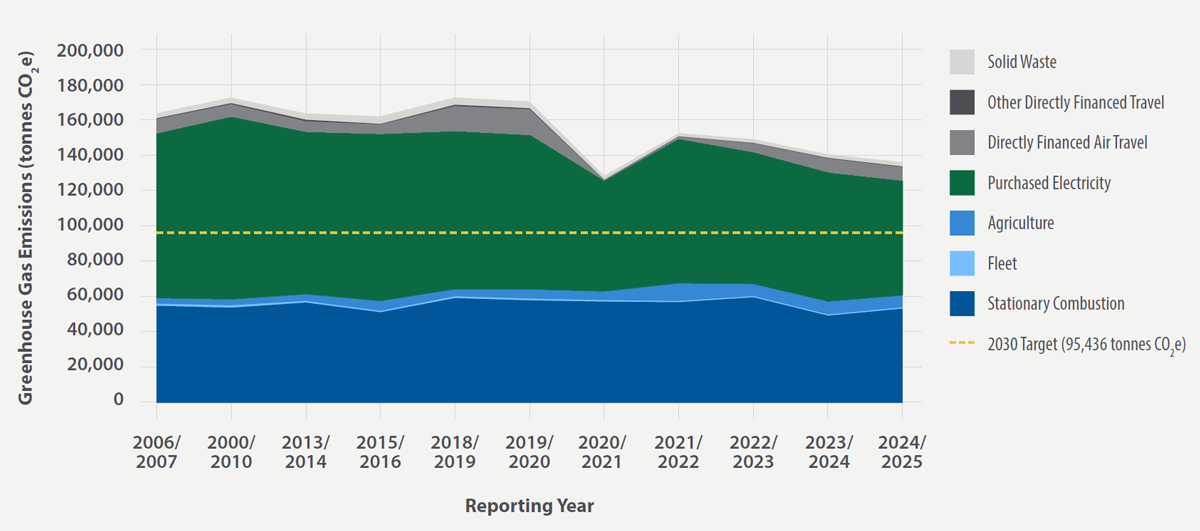
USask set ambitious climate targets that align with the United Nations Sustainable Development Goals, situating the university’s actions within an international framework. The university’s goal is to reach net-zero emissions by 2050. From 2010 to 2024, USask reduced GHG by 21%. 36 Figure 23 shows total USask GHG emissions by source from 2006/07 to 2024/25.
FIGURE 23. University of Saskatchewan Green House Gas Emissions
Beyond campus, USask works closely with the City of Saskatoon under a memorandum of understanding signed in 2018. This collaboration includes joint projects on climate action, stormwater management, and housing policy, as well as student-community partnerships and workshops that connect faculty expertise with municipal needs. The kihci-okâwîmâw askiy Knowledge Centre further strengthens relationships with Indigenous communities, supporting land-based knowledge and research that advances sustainability in culturally grounded ways. Through these actions, USask demonstrates that sustainability is not limited to its campus but extends outward into the broader community and province.
Commitment to Building Community
The University of Saskatchewan works to build community on campus and beyond in partnership with individuals and organizations regionally, nationally and globally. Whether it is through athletics, the arts, research or celebrations of different cultures and communities, USask strives to connect.
“We are all Huskies” is an expression commonly used at the University of Saskatchewan. The Huskies Athletic program games are a place where the community comes together. The courage and determination displayed in USask’s athletics program extends beyond the coaches and players to everyone connected to USask. That spirit also has an incredible economic and social impact on the city, province, and nation where they live, work, and play.

USask Huskies have a long history of excellence, with 28 team national championships, 216 individual national championships, 125 Canada West team championships, and 868 individual Canada West champions. The 2024/25 season was remarkable, with our Huskie women’s basketball team winning a national championship and Gage Grassick winning the top female athlete in Canadian university sports.
More than 400 student-athletes compete for the Huskies each year. Athletes are known to be excellent future leaders, business owners, and decision-makers, and USask keeps 70% of this future talent pool in province upon graduation. More than 3,500 youth are involved in grassroots camps, Junior Huskies, and Prospects programming, building their proficiency and leadership skills.
Huskie teams have the highest game attendance in the Canada West universities athletic association. With 97,903 people attending in the 2024/25 season, this was an all-time high attendance record. This attendance drives significant economic activity in the community, and at hotels, restaurants, and other local businesses.
Huskie athletes volunteer 2,600 hours per year to many community organizations, including schools, Big Brothers and Big Sisters, Ronald McDonald House, cancer research, the Jim Pattison Children’s Hospital, KidSport, and many more. In the 2024/25 season, the Huskies organization donated tickets to 700 different minor sports teams for a total value of $50,000.

Deeply committed to reconciliation, student athletes and coaches take part in many initiatives such as a beading program, a special home field football game, and the first varsity cross-country meet to be held on a First Nation within the Canada West conference. Celebrating Black History Month and promoting gender equity with a women’s scholarship initiative are two more examples of how Huskies are acting as a force for good.
USask researchers, students and staff also build community with other stakeholders through their commitment to solving shared and pressing challenges through innovation, collaboration, and a steadfast dedication to global well-being
- Statistics Canada (2022). Focus on Geography Series, 2021 Census of Population: Province of Saskatchewan.
- For more information, see https://policies.usask.ca/policies/operations-and-general-administration/deybwewin-taapwaywin-tapwewin.php.
- Yerema, R., and Leung, K., Mediacorp Canada Inc. (2025). Saskatchewan’s Top Employers 2025. 3 February 2025.
- University of Saskatchewan. (2025). 2024-2025 Annual Sustainability Report.
- Obid.
- University of Saskatchewan. (2025). 2024-2025 Annual Sustainability Report.