

Talent Needed to Sustain Growth
In a recent labour force report, Saskatchewan Premier Scott Moe observed that Saskatchewan needs the talents and skills of more workers to sustain growth despite Saskatchewan’s population being at its highest point in history.
“The number one challenge employers are facing as a barrier to the continued rate of growth is developing a labour force that maintains pace with the opportunities our economic success is creating.” 14
– Premier Scott Moe
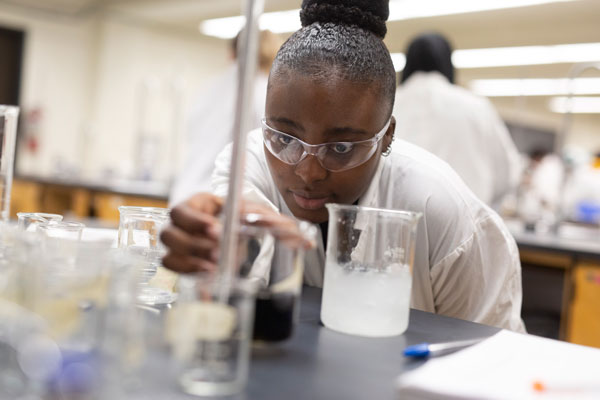
USask develops the workforce to meet this challenge.
Agriculture, natural resources and energy production, healthcare, and manufacturing, as well as emerging sectors, such as software, clean tech, and biotechnology, are driving Saskatchewan’s $110 billion economy. These industries require workers with university degrees in arts and sciences, engineering, software, health sciences, law, business and accounting, as well as workers in skilled trades. In 2024, Saskatchewan’s total employment reached 601,000 with a 5.3% unemployment rate. This is lower than the national unemployment rate of 7.1% and one of the lowest unemployment rates among Canadian provinces.15
USask’s Role in Generating a Skilled Workforce
As Saskatchewan’s premier research university and home to its only medical school, USask educates over 26,000 undergraduate and graduate students per year. USask offers undergraduate and graduate degrees and certificate programs from 17 colleges and schools. These degrees span health (dentistry, nursing, medicine, veterinary medicine, pharmacy, nutrition, public health, kinesiology, and physical therapy), society (business, law, education, public policy), engineering and the natural sciences, the social sciences, humanities, and the visual and performing arts. The degrees and certificates conferred by the University of Saskatchewan contribute to a broad range of professions that require post-secondary education.
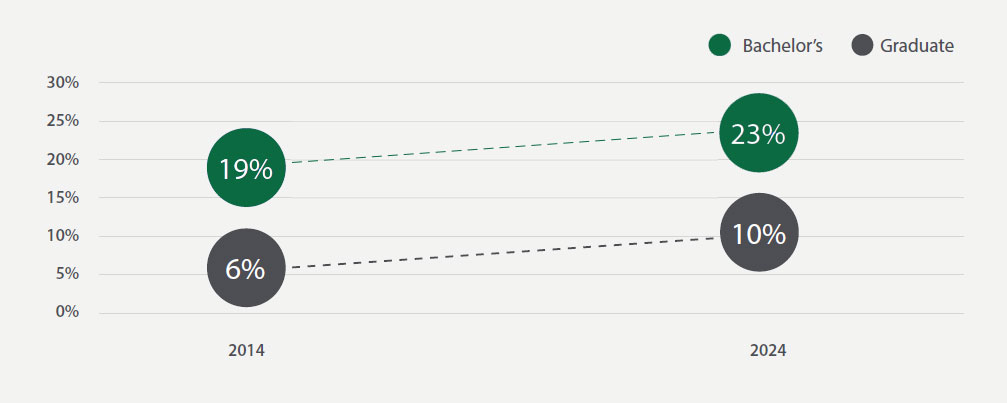
Over the past 10 years, the percentage of Saskatchewan workers 25 to 64 years of age with a bachelor’s degree grew to 23% and those with a graduate degree grew to 10%, as shown in Figure 7. This translates into 181,000 Saskatchewan residents (33%) out of a total workforce of 544,500 workers who had a bachelor’s degree or higher in 2024.16
USask colleges and schools
- College of Agriculture and Bioresources
- College of Arts and Sciences
- College of Dentistry
- College of Education
- College of Engineering
- College of Graduate and Postdoctoral Studies
- College of Kinesiology
- College of Law
- College of Medicine
- College of Nursing
- College of Pharmacy and Nutrition
- Edwards School of Business
- Johnson Shoyama Graduate School of Public Policy
- School of Environment and Sustainability
- School of Public Health
- School of Rehabilitation Science
- Western College of Veterinary Medicine
33%
33% of Sask workforce (workers ages 25-64) have a bachelor's degree or higher
26,000
USask educates over 26,000 undergraduate and graduate students per year
The degrees and certificates conferred by the University of Saskatchewan contribute to a broad range of professions that require post-secondary education.
FIGURE 7. Saskatchewan Labour Force, 25–64, with a Bachelor’s Degree or Higher, 2014 and 2024
Workforce Demand by Industry
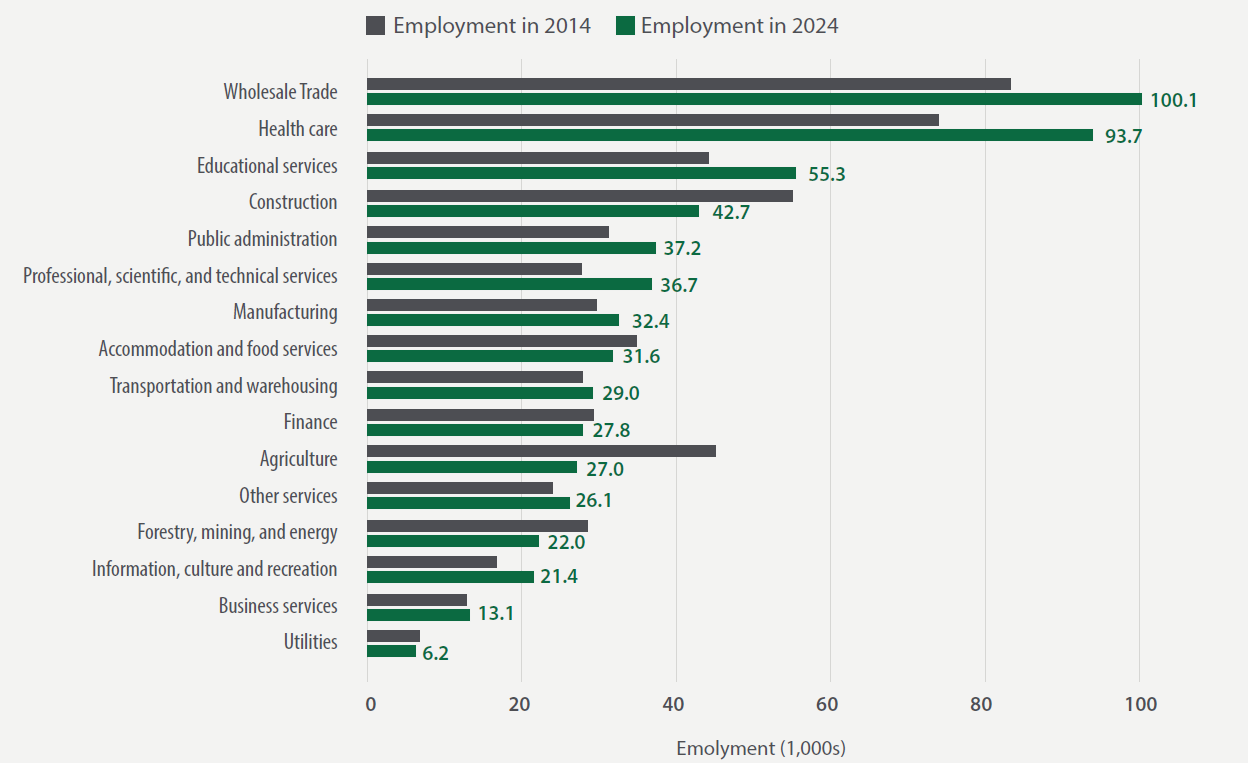
Which Saskatchewan industries are large and growing? Wholesale trade is the largest industry and includes companies that specialize in grain, livestock, and other agricultural products, industrial and agricultural machinery and equipment, and building materials. The next five largest industries in the province, measured by employment, are health care, higher education services, construction, public administration, and professional, scientific and technical services. All these industries, except construction, have expanded over the past 10 years, as shown in Figure 8.
FIGURE 8. Change in Saskatchewan Employment by Industry, 2014 and 2024
Companies in Saskatchewan’s leading industries require a broad range of skills and knowledge, from domain-specific scientific and technical expertise to business and operations management skills. USask is working to meet this need across multiple industries.
Agribusiness companies require people with expertise in plant science and crop protection, agribusiness, animal health and nutrition, agricultural technology and equipment, and food. In Figure 8, agribusiness companies are represented in both the wholesale trade industry, as well as agriculture industry, which is primarily farms. USask is producing graduates in biology, the agricultural sciences, bioinformatics and data science, agribusiness, and engineering, among others. Over the past 10 years, USask awarded 3,335 degrees and certificates in agriculture, agricultural operations, and related sciences, 2,105 degrees in biological and biomedical sciences, and 1,156 degrees in veterinary medicine, as shown in Figure 10.
USask’s impact on workforce is also seen in the energy production and natural resources sector. Every day, USask geology, physics, and engineering graduates help draw 458,000 barrels of oil, as well as potash and uranium, out of the Saskatchewan ground. They do this while applying their knowledge of how to reduce environmental impacts. Over the past 10 years, USask awarded 3,745 degrees in engineering, 1,000 degrees in the physical sciences, 840 degrees in natural resources and conservation, and 6,107 business certificates and degrees.
For the manufacturing industry, USask produces graduates in engineering, business, law, and computer science. Saskatchewan is home to many manufacturers, such as ABB (control systems), Akzo Nobel Chemicals, Atlas Industries (mining equipment), Calian Advanced Technologies (antennas and satcom products), CNH Canada (agricultural equipment), and Northwind Forest Products (treated wood). The Edwards School Business offers a Bachelor of Commerce in six majors: Finance, Human Resources, Management, Marketing, or Supply Chain Management.
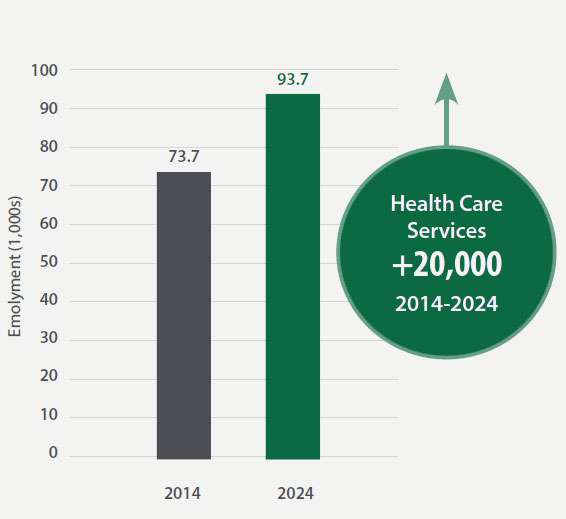
A final example is health care. Saskatchewan added 20,000 health care jobs over the past 10 years. USask produced 7,369 health professions and related clinical sciences graduates, representing 37% of the health care and related clinical service jobs created over the same 10-year period. Figure 9 illustrates the wide range of occupations needed by Saskatchewan’s health care industry.
FIGURE 9. Growth in Saskatchewan Health Care Jobs and Examples of Occupations Fuelling Growth, 2014–2024
Occupations Supporting Industry Growth
Nursing and nursing assistants
Physicians and physician assistants
Physical, occupational, speech, and respiratory therapists
Pharmacists
Dentists
Counselors and social workers
Business, financial, and human resource operations
Medical and health services managers
Life and physical, and social scientists
Community and social service specialists
Computer and information systems
Lawyers and legal occupations
Spotlight
Loading...
Degrees and Certificates Awarded
From 2015 to 2024, USask increased the total number of degrees and certificates it awarded by 10.8%, adding 470 degrees for a total of 4,807 degrees conferred in 2024/25. Over this 10-year period, USask awarded a total of 44,990 degrees and certificates to 38,772 students.
70%
Nearly 70% of University of Saskatchewan graduates stay in Saskatchewan.
Over the past 10 years, USask has contributed approximately 26,753 graduates with a post-secondary degree or certificate to the Saskatchewan workforce.
Nearly 70% of University of Saskatchewan graduates stay in Saskatchewan.17 Therefore, over the past 10 years, USask has contributed approximately 26,753 graduates with a post-secondary degree or certificate to the Saskatchewan workforce. These degrees and certificates are highly aligned to the employment needs of Saskatchewan’s leading companies and industries, as shown in Figure 10.
FIGURE 10. University of Saskatchewan Degrees and Certificates Awarded by Field of Study, 2015–2024
| Field of Study | Number of Degrees Awarded | % Total |
|---|---|---|
| Health professions and related clinical sciences | 7,369 | 16.4% |
| Education | 6,236 | 13.9% |
| Business, management, marketing and related services | 6,107 | 13.6% |
| Engineering | 3,745 | 8.3% |
| Agriculture, agriculture operations and related sciences | 3,335 | 7.4% |
| Social sciences | 2,387 | 5.3% |
| Biological and biomedical sciences | 2,105 | 4.7% |
| Computer and information sciences and support services | 1,611 | 3.6% |
| Psychology | 1,531 | 3.4% |
| Parks, recreation, leisure and fitness studies | 1,379 | 3.1% |
| Legal professions and studies | 1,333 | 3.0% |
| Veterinary medicine | 1,156 | 2.6% |
| Physical sciences | 1,000 | 2.2% |
| Natural resources and conservation | 840 | 1.9% |
| Other fields of study | 827 | 1.8% |
| Public health | 760 | 1.7% |
| Public administration and social service professions | 637 | 1.4% |
| English language and literature/letters | 592 | 1.3% |
| Visual and performing arts | 517 | 1.1% |
| History | 385 | 0.9% |
| Area, ethnic, cultural and gender studies | 301 | 0.7% |
| Mathematics and statistics | 244 | 0.5% |
| Architecture and related services | 225 | 0.5% |
| Family and consumer sciences/human sciences | 218 | 0.4% |
| Philosophy and religious studies | 150 | 0.3% |
| Total | 44,990 | 100% |
Source: University of Saskatchewan Data Warehouse
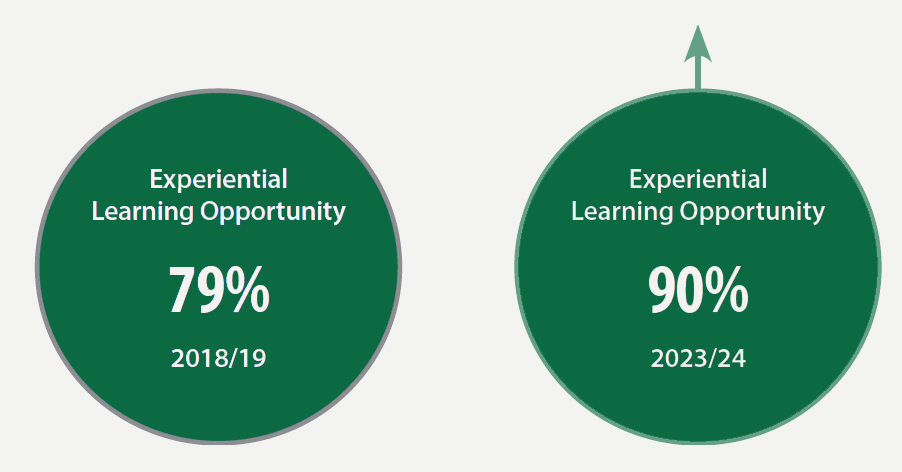
USask has a goal of 100% of undergraduate students participating in at least one experiential learning opportunity before they graduate. Experiential learning refers to a range of programs that give students an opportunity to gain hands-on experience and develop critical skills. USask understands that these experiences—be they research experiences, co-ops, internships, clinical experiences, or field practicums—help prepare USask students for their future careers. The percentage of USask students who participated in at least one experiential learning opportunity increased from 79% in 2018/19 to 90% in 2023/24, as shown in Figure 11.
FIGURE 11. Percentage of Undergraduate USask Students Participating in at Least One Experiential Learning Opportunity, 2018/19 and 2023/24
Impact on a Sector: Health Care
USask plays a critical role in producing graduates that help address acute workforce shortages in particular industries. Health care is one such sector facing shortages, especially in rural areas, due to a confluence of factors that include the retirement of existing workers, strong growth in demand for health care services by an aging population, and attrition of workers following the COVID-19 pandemic.
As mentioned, USask is home to Saskatchewan’s only medical school and has graduated 968 physicians and 3,088 nurses over the past 10 years to meet the demand for health professionals across the province and Canada. The same is true of USask’s role in producing other high-need professionals, such as clinical psychologists, pharmacists, dentists, and physical therapists. USask graduates account for 75% of registered dentists in Saskatchewan and 78% of registered pharmacists.18 Nearly 40% of licensed PhD-level psychologists in Saskatchewan are USask graduates, and these graduates report a 100% employment rate in their field. Figure 12 shows the number of health professional and related clinical services degrees awarded by USask over the past 10 years.
FIGURE 12. USask Health Professional and Related Clinical Services Degrees and Certificates Awarded, 2015–2024
| Field of Study | Number of Degrees Awarded | % Total |
|---|---|---|
| Nursing | 3,088 | 41.9% |
| Medicine | 968 | 13.1% |
| Pharmacy | 918 | 12.5% |
| Physiology and pharmacology | 843 | 11.4% |
| Dentistry | 532 | 7.2% |
| Physical therapy | 344 | 4.7% |
| Nutrition | 262 | 3.6% |
| Nurse practitioner | 153 | 2.1% |
| Health sciences | 84 | 1.1% |
| Global health | 83 | 1.1% |
| Clinical psychology | 48 | 0.7% |
| Physiology | 27 | 0.4% |
| Pharmacology | 17 | 0.2% |
| Precision oral systemic health | 1 | 0.0% |
| Biological psychiatry | 1 | 0.0% |
| Total | 7,369 | 100% |
Source: University of Saskatchewan Data Warehouse
USask helps alleviate pressure on the health care system. For example, medSask, based at USask, provides over 20,000 pharmacists across Canada guidelines for prescribing treatments for minor ailments. With six million Canadians lacking a family doctor, medSask helps reduce emergency room wait times and improves access to care. It handles more than 8,000 calls annually and is a nationally recognized health care resource.
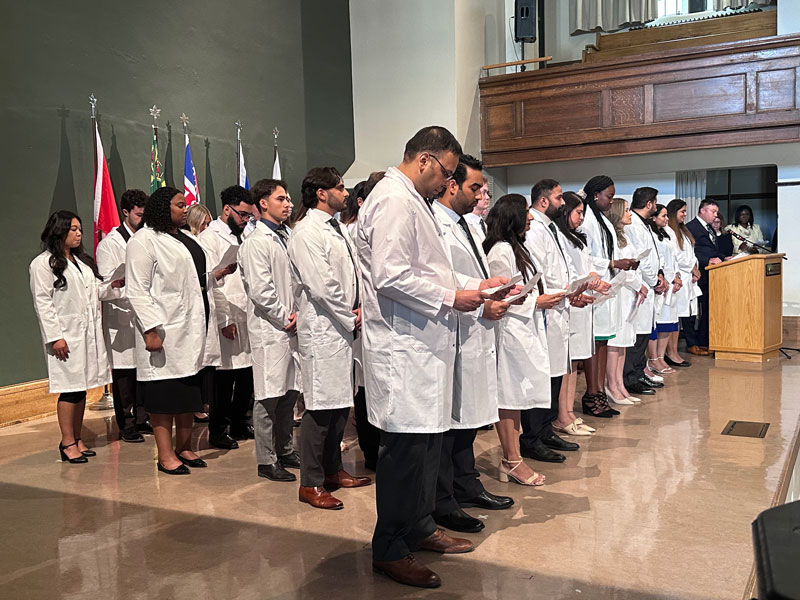
The USask College of Dentistry Dental Clinic is a teaching clinic. It provides a wide range of dental services to the public at reduced costs, while also serving as a training ground for students under the supervision of licensed dentists. In 2024/25, the clinic had 19,581 patient visits, including 785 emergency visits and 801 pediatric patient visits. The clinic serves 213 different communities that together equals 45% of the 469 cities, towns, and villages in the province.
USask uses distributed programs to train health professionals right in their own communities. Approximately 35% of bachelor of nursing (BSN) students conduct their studies outside the main Saskatoon campus in 10 locations across Saskatchewan; in 2024/25. 620 students graduated in Regina, 490 in Prince Albert, 110 in Yorton, 74 between La Ronge and Ile-a-la-Crosse, and 12 in Lloydminster. In 2027, the first BSN students in North Battleford and Muenster will graduate, while the first BSN students in Weyburn and Swift Current will graduate in 2028. This is an incredible training pipeline for rural health clinics in Saskatchewan.
- Government of Saskatchewan (2024). Building the workforce for a growing economy: The Saskatchewan labour market strategy.
- Statistics Canada. (2025). Labour force survey estimates, Table 14-10-0017-01.
- Statistics Canada. (2025). Labour force characteristics by educational degree, annual, table 14-10-0118-01.
- This is the midpoint between the USask Alumni Association estimate of 60.8% of all living alumni residing in Saskatchewan and the most recent Ministry of Advanced Education estimate of 77% of 2019 graduates still residing in Saskatchewan after 2 years.
- Data are from the College of Dental Surgeons of Saskatchewan and the Saskatchewan College of Pharmacy Professionals.