

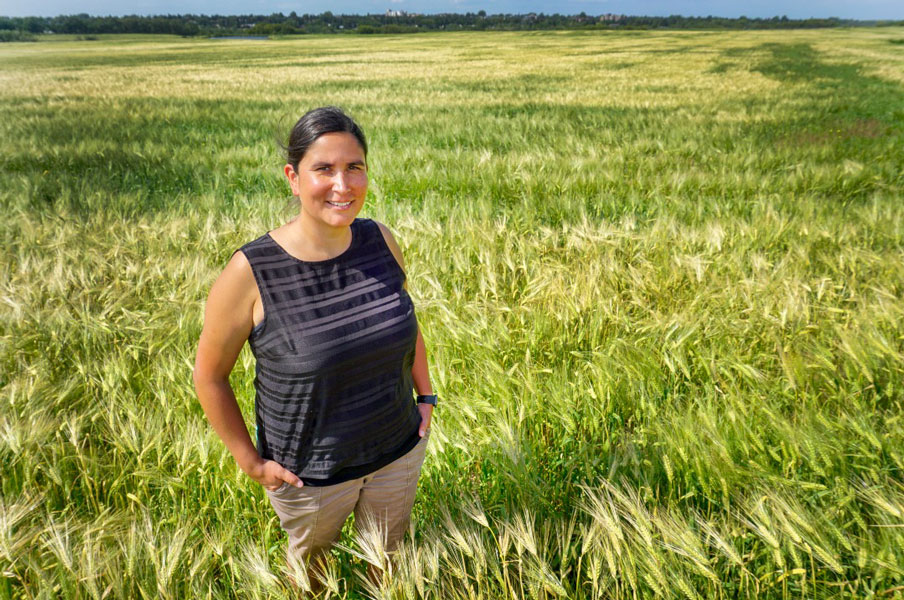
SAGE supports cultural revitalization and community-led land stewardship
A USask project guided by Indigenous knowledge and values is dedicated to advancing soil health and sustainable land stewardship in partnership with Indigenous communities.
A USask project guided by Indigenous knowledge and values is dedicated to advancing soil health and sustainable land stewardship in partnership with Indigenous communities.
The ē kanātahk askiy Soil and Agroecosystem (SAGE) Health Project has created a network across the Prairies to share soil and agroecosystem health knowledge from Indigenous and western science perspectives for First Nations and Métis communities.
The name ē kanātahk askiy was gifted to the project through ceremony by Elder Margaret Larocque. It is a phrase in ᓀᐦᐃᔭᐍᐏᐣ nēhiyawēwin that can be translated to “it is a clean earth.” Those associated with SAGE—including USask alumna Dr. Melissa Arcand (PhD’13), an associate professor in the Department of Soil Science in USask’s College of Agriculture and Bioresources—have taken this as a call to action to guide their work.
“I am inspired by working collaboratively with people from diverse perspectives and backgrounds. It helps to think about my own research in a new light,” said Arcand, a member of the Muskeg Lake Cree Nation who is working in partnership with the Bridge to Land Water Sky Living Lab led by Mistawasis Nêhiyawak, Saskatchewan Aboriginal Lands Technicians, and the International Buffalo Relations Institute. “I am also inspired to do work that can help individuals and communities make informed decisions when it comes to agricultural practices and land management.”
In 2023, the SAGE project was awarded $1.4 million through the Weston Family Soil Health Initiative to develop land-based training workshops for First Nations communities, land managers, and producers who farm First Nations lands.
Across the three Prairie provinces, First Nations steward more than 1.5 million acres of cropland, largely through rental agreements with non-Indigenous farmers. SAGE delivers hands-on education to empower First Nations land managers, leadership, and farmers to adopt beneficial management practices (BMPs) that improve soil and ecosystem health, while sustaining the long-term productivity of their soils. Other interconnected SAGE knowledge-sharing opportunities focus on buffalo rematriation, Indigenous food sovereignty, and soil health assessment and monitoring. Together, these SAGE pillars support resilient agroecosystems, cultural revitalization, and community-led stewardship of the land.