

USask Economic and Social Impact Analysis, 2024/25
Summary
About this study
The University of Saskatchewan (USask) is an esteemed institution that has educated generations of people in Saskatchewan, Canada, and across the world since 1907. This economic and social impact study demonstrates the myriad ways USask, a premier Canadian research university and member of the U15 Canada, has contributed to the economic growth and social and environmental well-being of the province, the country, and the world.
Objectives
The goal of this social and economic impact study is to provide a comprehensive analysis of USask’s dynamic and multidisciplinary impact locally (on the City of Saskatoon), regionally (on the Province of Saskatchewan), nationally, and internationally.
The study aims to:
- Quantify the economic impact of USask’s operations, student and visitor spending, research activities, innovations and startup activity, and alumni contributions.
- Identify and evaluate the social value USask provides to its community, including reconciliation with Indigenous communities and contributions to public health, cultural enrichment, and social innovation.
- Showcase USask’s leadership role in driving economic resilience, reconciliation, sustainability, and innovation in Saskatchewan, in Canada, and beyond.
Development
Funding for this report
Funding for this report was provided by long-time University of Saskatchewan alumni, donors, and friends, Margrit (Grit) McCreath (BEd ’91) and Scott McCreath (BComm ’69). Grit served as Chancellor of the University of Saskatchewan from 2019 to 2025. Scott served as Executive in Residence at the Edwards School of Business from 2014 to 2025 and currently sits on the Edwards Dean’s Advisory Council.
RTI International
RTI International, an independent, scientific research institute dedicated to improving the human condition, performed this economic and social impact study on behalf of USask. This report is the culmination of this work.
The development of the University of Saskatchewan Economic and Social Impact Analysis study was led by Jennifer Ozawa, Alan O’Connor, Meaghan McGrath, and Shannon Wells at RTI International in collaboration with the Office of the Vice President, University Relations and a working group created to support the study. Richard Hall created the report design, and Christina Rodriguez was the editor. Many thanks to Cheryl Hamelin, Vice President, University Relations; Heather Persson, Associate Vice President for Strategic Communications and Chief Communications Officer; and Melanie Nahachewsky, Senior Project Manager for their tremendous work on this study.
Impact study working group members
Sincere thanks is extended to the Impact Working Group members for their important contributions to this study. They are listed in alphabetical order:
Jennifer Beck, Chief Resource Allocation and Planning Officer
Loleen Berdahl, Acting Deputy Provost
Vince Bruni-Bossio, incoming President and Vice-Chancellor
Sara Daniels, Associate Vice-President Government Relations
Troy Harkot, Chief Analytics Officer
Cheryl Hamelin, Vice-President, University Relations
Deidre (Dee) Henne, Chief Financial Officer
Patti McDougall, Interim Provost and Vice-President Academic
Melanie Nahachewsky, Senior Project Manager
Heather Persson, Chief Communications Officer, Associate Vice-President Strategic Communications
To perform this analysis, RTI sourced a variety of education, economic, workforce, research, and innovation data. Some of these data came from internal sources and consultations with USask Alumni Relations; Campus Operations; Strategic Finance Office; Assessment and Analytics; Huskie Athletics; Research Profile and Impact; Sustainability; Strategic Communications and Marketing; Government Relations; Indigenous Engagement; Teaching Innovation; and Equity, Diversity, and Inclusion initiatives. RTI also drew on external data sources, including the Saskatchewan Ministry of Advanced Education, Statistics Canada, and the Association of University and Technology Managers.
RTI then analyzed the quantitative and qualitative data to answer the key impact questions and generate key findings for each dimension of this study. The RTI team worked closely with the USask Impact Study Working Group who provided ideas and feedback on early drafts. Contributions from the Deans’ Council and the Senior Leaders Forum were significant in shaping this report, providing ideas, feedback, and impact examples from across units. These insights informed the approach and guided the development of the analysis and narrative.
Appendix
Please see the Appendix for the full list of economic impact studies and benchmark peers.
Supporting Saskatchewan’s “30 by 2030” Growth Plan goals
USask is helping the Government of Saskatchewan achieve 90% of its 30 goals to build a strong economy, strong communities, and a stronger Saskatchewan by 2030.
$2.0B
USask increases Saskatchewan’s GDP by $2.0 Billion
$2.4B
USask increases Canada’s GDP by $2.4 Billion
13.3K
USask employs 13,320 jobs directly and indirectly
Every $1 invested in USask by the Saskatchewan government generates $3.64 of GDP and $1.99 in labour income.
USask as an economic engine
University Operations and Investment
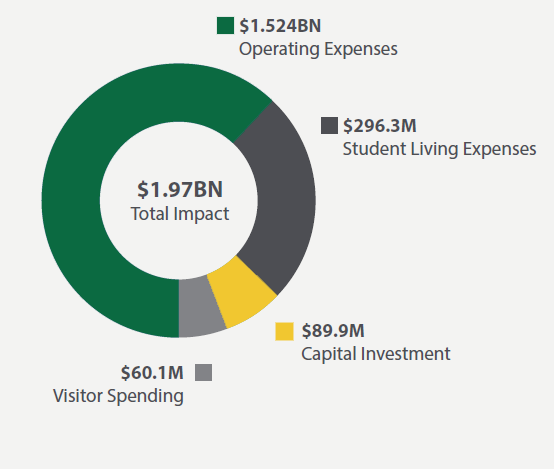
USask is a cornerstone of Saskatchewan’s higher education system and society. It is also an economic engine for the province. In 2024/25, USask generated $2.0 billion of Saskatchewan’s gross domestic product (GDP), and contributed $2.4 billion to Canada’s GDP. USask also supported 13,320 jobs and over $1 billion in labour income. For every $1 the Government of Saskatchewan invests in USask, USask brings in $1.48 from non-provincial government sources.
26,648
USask enrolled 26,648 students in 2024/25
4,807
USask conferred 4,807 degrees and postgraduate certificates across a range of programs in 2024/25
8%
USask has helped Saskatchewan increase its percentage of workers with a bachelor’s degree or higher from 25% in 2014 to 33% in 20245
Over the past 10 years, nearly 70% of USask graduates have remained in the province meaning that USask contributed 26,753 graduates to the Saskatchewan workforce over this period.4
USask as a workforce generator
Contribution to Saskatchewan’s labour force
USask offers a thriving, dynamic campus that welcomes and attracts a diverse student body from 130 countries. It contributes to the employment and economic livelihoods of its graduates and, in doing so, fuels the growth of companies and industries in the provincial, national, and global economy.
As Saskatchewan’s flagship research university, USask is home to the province’s only medical, dental, pharmacy and nutrition, agriculture and bioresources, veterinary medicine, and law schools. It provides Saskatchewan’s public and private sectors with graduates who are equipped with a broad range of scientific and technical expertise in addition to business and operational management skills.
“The number one challenge employers are facing as a barrier to the continued rate of growth is developing a labour force that maintains pace with the opportunities our economic success is creating.”3
– Premier Scott Moe
$1.3M+
Over a working lifetime of 40 years (25 to 64 years of age), an individual with a graduate degree will earn, on average, $1,394,000 more than a person with a high school diploma.
$13K
For each additional degree earned at USask, the average annual earnings increases by $13,000.
17%
In Saskatchewan, the employment rate for individuals with a bachelor’s degree or higher is 77% compared to 60% for individuals with a high school degree.
The USask education advantage
Earnings premium of a USask degree
A USask education is an employment advantage. Graduates report higher employment rates and higher earnings. With each subsequent USask degree, a graduate will earn an additional $13,000, on average.6
$4M
In 2023/24, USask reported nearly $4 million of gross licensing income.
3x
The licensing income generated from USask-developed technologies is consistently three times higher than peer institutions.
$321M
USask receives $321 million in research revenue.
The income USask generates from licensing USask-developed technologies is consistently three times higher than the median of $1.4 million reported by 47 Canadian and U.S. research institutions with similar research expenditure levels.
USask as a driver of research and innovation
USask research is a source of optimism. USask faculty and students tackle important problems from water scarcity to human health. USask is the only university in the country to host four Major Science Initiative (MSI) national research centres: the Vaccine and Infectious Disease Organization (VIDO); the Canadian Light Source (CLS), which houses Canada’s only synchrotron; the Super Dual Auroral Radar Network (SuperDARN); and the Global Water Futures Observatories (GWFO).
USask also has an excellent track record of translating its research into products, services, and knowledge that benefit people, companies, and society. The licensing income generated from USask-developed technologies, a lead indicator of innovation activity, is consistently three times as high as peer Canadian and U.S. institutions that perform similar levels of research activity.7 Research translation has resulted in licences for new crop varieties with improved traits, agricultural technology, animal vaccines, and more.
USask as a catalyst for change
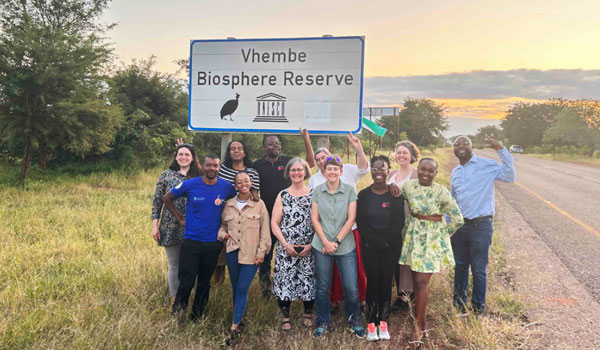
USask is a catalyst for change, supporting Indigenous economic sovereignty, addressing pressing environmental and social challenges, and solving problems through innovative solutions with community partners. As Saskatchewan and the University of Saskatchewan look to the future, they will continue to strive to Be What the World Needs.
Conclusion: Aspiring to Be What the World Needs

The University of Saskatchewan is a highly regarded institution institution that has educated hundreds of thousands of people around the world including generations of Saskatchewan people. A USask education provides certainty about the future through the completion of degrees in sought-after fields. USask graduates include entrepreneurs, lawyers, teachers, writers, doctors, public leaders, corporate leaders, and professional athletes, to name but a few.
USask contributes to the employment and economic livelihoods of its graduates, and in doing so fuels the growth of companies and industries in the provincial economy. With $1.2 billion in direct operating expenditures and 6,647 employees, USask is an economic engine for the province. Its expansion over the past 10 years has driven secondary economic activity in the province and in Canada through its spending, employment, and renovation and new construction effects. When these secondary impacts are included, USask’s total GDP impact is $2 billion in Saskatchewan and $2.4 billion in Canada.
USask research is a source of optimism. USask faculty and students tackle important problems from water scarcity to human health. USask discoveries generate new understanding and new solutions to some of the greatest challenges at both the local and global level.
As the University of Saskatchewan looks to the future, it continues to strive to Be What the World Needs—an institution that embodies the belief that the world can be better. In uncertain times, USask offers educational programs that help students attain future career stability. Through its research and innovation activity, USask seeks to solve problems that will ensure the future security of Saskatchewan’s health, environment, and economy.
Spotlight
Loading...
- Government of Saskatchewan. (2024). Building the workforce for a growing economy: The Saskatchewan labour market strategy.
- RTI leveraged two data sources to develop an estimate of the percentage of USask alumni who have remained in the province over the past 10 years. At the low end, the USask Alumni Association reports 107,745 alumni residing in Saskatchewan out of a total of 177,168 total living alumni, or 60.8%. On the high end, the most recent Ministry of Advanced Education graduate outcomes survey of 2019 graduates found that 77% of USask graduates were still living in the province 2 years after graduation. RTI took a midpoint of 69% and applied it to the 38,772 students to whom USask awarded degrees and certificates over the past 10 years to derive the estimate of 26,753 graduates remaining in Saskatchewan.
- Statistics Canada. (2025). Labour force characteristics by educational degree, annual, table 14-10-0118-01.
- Province of Saskatchewan (2025). Earnings premium of Saskatchewan post-secondary credentials, 2022 graduates.
- RTI analysis of AUTM Statistics Access for Technology Transfer data for 320 universities and academic medical centers in Canada and the United States over the past 10 years.